
Armor of God Bible study: Ephesians 6, piece by piece
A plain walk through the armor of God in Ephesians 6, with the Old Testament lines behind the pictures, and a way for a parent or teacher to teach it.
Published 2026-11-03 · Updated 2026-11-03
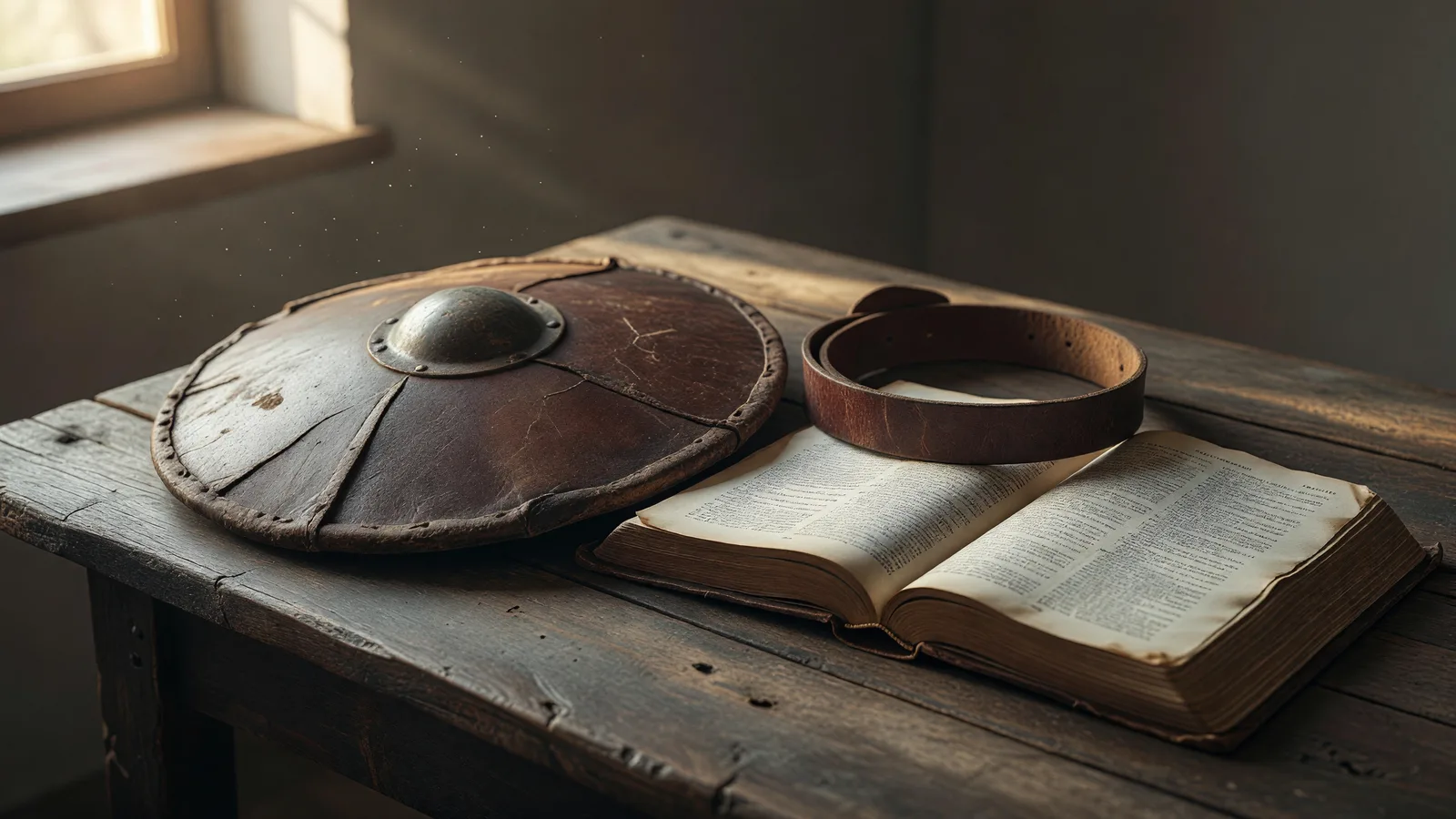
The armor of God is a picture in Ephesians 6:10-18, not a list of loose objects. In the Berean Standard Bible the passage tells the letter's recipients to be strong in the Lord, to put on the full armor of God, and to stand. Then it names the pieces, and it ends in prayer. That is the whole study in one breath. The rest of this page walks the pieces in order, sets three older lines beside them, and closes with how a parent or teacher can teach it to children. You are the reader here. The children are not.
Don't just read the Bible, understand it. For this passage, that means hearing who wears what, before anyone makes a costume.
Stand first
Ephesians 6 opens the picture by telling the letter's recipients to be strong in the Lord and in His mighty power, not in strength of their own. The line is: "be strong in the Lord and in His mighty power." The next line says why the armor is there: "Put on the full armor of God, so that you can make your stand against the devil's schemes." The struggle, the text says, "is not against flesh and blood, but against the rulers, against the authorities, against the powers of this world's darkness, and against the spiritual forces of evil in the heavenly realms."
Then the command repeats. The letter tells its recipients to take up the full armor so that when the day of evil comes, they can stand their ground, and having done everything, to stand. The pieces that follow are how the letter fills in that "stand." The New World Encyclopedia entry on the letter notes the same charge in its summary of the letter's closing ethics: a believer should put on the "whole armor of God" in his spiritual fight. The chapter page is where the pieces are actually named.
Belt and breastplate
"Stand firm then, with the belt of truth buckled around your waist, with the breastplate of righteousness arrayed." Truth is the belt. Righteousness is the breastplate. The letter does not stop to define either word here. It assumes the letter's first readers have already met truth and a new way of life earlier in the letter.
Two older lines use the same pictures, and they are not identical to this one. In Isaiah 11:5, of the shoot from Jesse, "Righteousness will be the belt around His hips, and faithfulness the sash around His waist." That is a belt of righteousness and a sash of faithfulness, on a coming king. Ephesians names a belt of truth. The image is kin. The labels are not the same, and a careful reading keeps them apart.
In Isaiah 59:17 it is the LORD who dresses for action: "He put on righteousness like a breastplate, and the helmet of salvation on His head." He also puts on garments of vengeance and a cloak of zeal. Ephesians tells the reader to wear a breastplate of righteousness. It does not tell the reader to wear vengeance. The older line is about God clothing himself because no one else would intercede. The letter's line tells its recipients to stand with a breastplate of righteousness. Say that difference out loud if you teach this. It keeps the picture from turning into a threat.
Feet, shield, helmet, and sword
"With your feet fitted with the readiness of the gospel of peace." The piece is not a shoe collection. It is readiness, and the readiness belongs to the gospel of peace. Isaiah 52:7 is the line readers hear under this one: "How beautiful on the mountains are the feet of those who bring good news, who proclaim peace, who bring good tidings, who proclaim salvation." Isaiah praises the messenger's feet. Ephesians fits the reader's feet with readiness to carry that kind of news. Again, kin, not a copy.
"Take up the shield of faith, with which you can extinguish all the flaming arrows of the evil one." Faith is the shield. The text's own picture is arrows that are put out, not a mood the recipients have to manufacture. The line names faith as what is taken up, not as a feeling the recipients must wait to feel.
"Take the helmet of salvation and the sword of the Spirit, which is the word of God." Salvation is the helmet, the same pairing Isaiah 59 uses for the LORD's own head. The sword is not a private slogan. The letter says it is the word of God. When you teach this, "the word of God" can stay as large as the letter means it: the message they have received, not a single verse used as a weapon against a person in the room.
Prayer is the close, not a spare piece
The passage does not stop at the sword. "Pray in the Spirit at all times, with every kind of prayer and petition." The letter tells them to stay alert and to pray for all the saints. Paul then asks prayer for himself, an ambassador in chains, that he may speak the gospel fearlessly.
People often ask for seven pieces, in order. The text does not number them. In order it names six: belt of truth, breastplate of righteousness, feet fitted with the readiness of the gospel of peace, shield of faith, helmet of salvation, sword of the Spirit. Then it says pray. A lesson may count that prayer with the six and call the set seven. That is a teaching choice. It is not a number the passage prints. If you teach children, you can say "these are the pictures, and then we pray," and you will be closer to the chapter than a poster that forces a seventh object.
How a parent or teacher can teach it
You read it first, in the order above, including the Isaiah lines, so you do not hand a child a picture you have not looked at. Then tell the pictures in short sentences. The letter names a belt, a covering for the chest, feet ready with news of peace, a shield, a helmet, and a sword, and then a call to pray.
One piece at a time is enough. A belt from a drawer, a picture of a shield, or nothing but the words will do. You do not need a costume, and you do not need to scare anyone with the arrows. Ask one question a child can answer: "Which picture do you want to remember?" Let the answer be small. Close with a short prayer in their hearing, the way the passage itself closes. If the child is young, keep it short. Older children can read the chapter with you and find the Isaiah lines themselves.
Keep the lesson reassuring. Do not put frightening burdens on children. This page shows the pieces and the older lines. It does not replace reading Ephesians 6:10-18 in a Bible with them.
If you want it printed for a class
When you want the adult plan, the retelling, and a craft already laid out, The Armor of God: kids Bible lesson and craft is made to teach one Bible story, Ephesians 6:10-18, to children about 4 to 10, with a craft, in about 35 minutes, at $4. For the adult it has the background, the aim, what to print and gather, and a step-by-step plan. It includes 6 questions with answers, a picture to color, and a memory verse, Ephesians 6:10 in the Berean Standard Bible, with cards to cut out. It is sold to parents and teachers. A personal copy covers one household or one teacher's own class. Parents and teachers receive an instant digital download, one ZIP of PDF files, and nothing ships. Craft supplies are not included.
You can teach the passage from this page and your own Bible and never open that file. If you do open it, you are still the one in the room. The file does not teach the class for you.
Questions
What is the armor of God in scripture?
In Ephesians 6:10-18 the armor is a set of pictures for standing firm: truth, righteousness, the readiness of the gospel of peace, faith, salvation, and the word of God, with prayer at the end.
What book in the Bible teaches about the armor of God?
The letter to the Ephesians. The passage sits near the end of that letter, after instructions for households, and tells the reader to put on the whole armor of God.
What are the 7 pieces of armor of God in order?
The passage does not number seven pieces. In order it names the belt of truth, the breastplate of righteousness, feet fitted with the readiness of the gospel of peace, the shield of faith, the helmet of salvation, and the sword of the Spirit, then it calls the reader to pray. Some lessons count that prayer as a seventh piece. The text lists the six and then the prayer.
- Ephesians 6, Berean Standard Bible
- Isaiah 59, Berean Standard Bible
- Isaiah 11, Berean Standard Bible
- Isaiah 52, Berean Standard Bible
- Epistle to the Ephesians