
Bible study notes: four lines to write
What to write when you study a passage: background, observation, one question, and one next action, with a worked notes page.
Published 2026-11-03 · Updated 2026-11-03
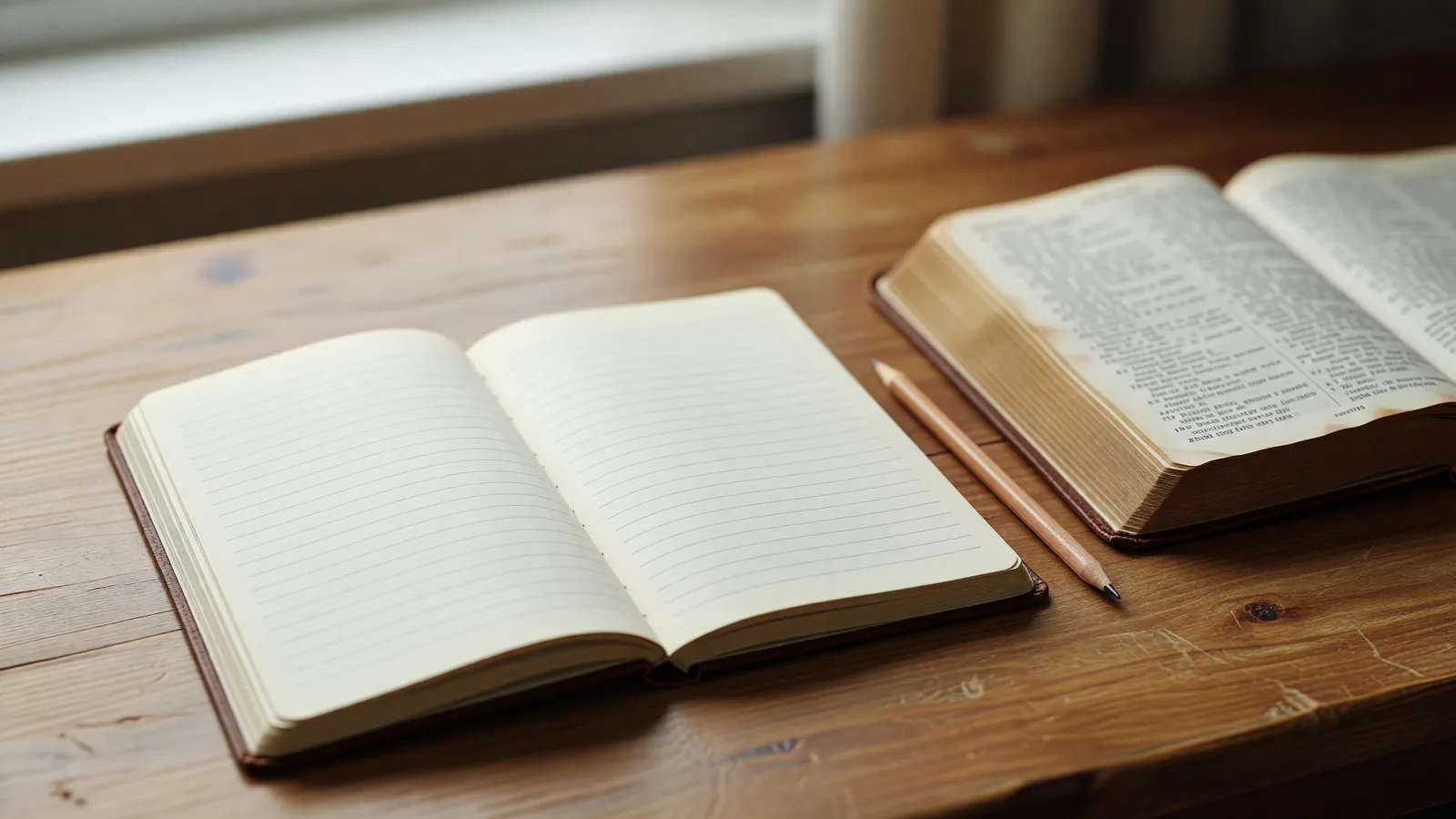
Bible study notes are four lines on one passage: background, observation, question, and application. Write them in that order, in your own words, and stop when the four lines are done. Don't just read the Bible, understand it.
A blank notebook does not tell you what belongs on the page. These four lines do. The notes are a record of one sitting, not a substitute for the passage.
Four lines to finish before you close the book
Keep the passage short enough to finish in one sitting. A single scene, a short poem, or one argument in a letter is enough. A whole book is a reading plan, not a notes page. That longer stretch is covered on the Bible reading plans page. A fuller routine for the same sitting is on how to study the Bible.
Write the reference and the date at the top, then these four lines.
Background. Two sentences at most. What kind of writing is this: a story, a letter, a poem, a law, or a vision? Who is speaking or acting? Where does this passage sit in the book? You are parking the lines in their setting so a sentence does not float free.
Observation. Only what the sentences say. Who acts. What they do. Which words repeat. What is set beside what. Leave out what you wish the passage said.
Question. One question the passage can answer. Answer it in a sentence you could read back tomorrow. If the answer needs a fact the passage never states, you asked past the text. Save that question.
Application. One next action that follows from the answer. Small enough to do before the next sitting. A speech is not an application. A single checkable action is.
Then stop. A longer page is optional. A finished note is the study.
What belongs in the background line
The background line is not a research paper. It is a fence. It keeps tonight's note from treating a poem as a letter, or a law as a promise addressed to you.
Three questions are enough. What kind of writing is this? Who is in the scene, and who was it for? What happened just before this passage in the same book? If you cannot answer the third, say so and move on. An honest blank is better than a guess.
You do not need a stack of books for this line. Read the opening lines of the chapter, and the closing lines of the chapter before it, if there is one. Name the kind of writing and the people the passage names. That is a background. If the same book comes up again, copy the setting forward and add only what is new.
What belongs in the observation line
Got Questions describes inductive study as three steps. Observation asks what the text says. Interpretation asks what it means in context. Application asks what it means for your life. The observation line is that first step, written down, before you decide what the passage means.
Stay inside the sentences. Mark names, places, and words that repeat. Mark commands, questions, and contrasts. If a word is unclear, write the word and a question mark. Do not replace it with a synonym you like better. The observation line should still be true if someone checks it against the Bible in your hand.
A useful test: could someone tick every clause in your observation against the passage, with no commentary open? If a clause fails, move it to the question line or cut it.
The Berean Standard Bible text of the opening psalm is a clean place to practice, because the poem is short and the contrast is on the surface. One line of that text says, "But his delight is in the Law of the LORD, and on His law he meditates day and night."
That sentence names a delight and a habit. It names the law as the thing delighted in. It does not assign you a task for tomorrow. That task, if you write one, belongs in the application line, after you have said what the poem says.
What belongs in the question line
The question line is the interpretation step, kept to one question so the page stays a note.
Ask something the passage can answer. "What does this poem say the person does with the law?" is that kind of question. "Why do hard weeks happen?" is not, unless this passage is about that. Answer in one or two sentences, and point each sentence back to a line you already wrote in the observation.
If two readings are both possible from the text, write both and mark them as open. Readers differ on some passages. A notes page should show the open question, not hide it under a confident line.
One answered question teaches more than a list you never return to. Extra questions can wait on the back of the page.
What belongs in the application line
Application is the third step in that same inductive description: what the passage means for your life, turned into one action.
Match the action to the answer, not to a mood. If the poem praises meditating on the law, the action might be to read a short law passage at the next sitting and write one observation from it. Do not invent a duty the passage never mentions.
Keep the action small. "Be better" cannot be checked. "Read the next short section and write what it says" can. Date the action. When you open the notebook next time, look at that line first. Either you did it, or you did not. Both are useful information. Then start a new page.
An illustrative notes page on the opening psalm
The page below is illustrative. The wording is a sample, not a script. Use your own passage, and write your own four lines. Verse numbers here are only so you can find the lines in the poem.
Reference. The opening psalm, a poem at the start of the book of Psalms.
Background. This is a poem, not a letter and not a story with a plot. It sets one person beside another. The first person refuses certain company and delights in the law. The other is called wicked, and later compared to chaff. No date and no city are named in the poem, so the background line stops there.
Observation.
- The opening line names three refusals: the counsel of the wicked, the path of sinners, and the seat of mockers.
- The next line names delight in the law, and meditation on it day and night.
- Later lines compare that person to a tree planted by streams of water, yielding fruit in season, with a leaf that does not wither.
- The wicked are compared to chaff driven off by the wind.
- The closing line says the LORD guards the path of the righteous, and the way of the wicked will perish.
Question. What does this poem say the person does with the law, and what picture does it give for the result?
Answer. The person delights in the law and meditates on it day and night. The picture of the result is a tree by water that yields fruit in season. The poem does not say the tree never faces wind. It says the leaf does not wither, and it sets that picture against chaff.
Application. At the next sitting, read a short law passage the poem is praising, and write one observation line from it before asking what to do about the week. That is the whole action.
Nothing in this sample settles what the law requires in every case. It only shows the four lines filled from one poem.
When a printed day page is easier than a blank book
Some nights the hard part is the background line, not the pen.
Understand the Bible: every book explained + 30 guided days includes a guide to each of the 66 books: what it is about, setting, where it fits, key people, three passages to start with, one question, and Your First 30 Days: 30 guided days. Each day has background first, the passage to read, 2 or 3 things to notice, one question with answer lines, and a one-line prayer, in about 15 minutes. Delivery is an instant digital download, one ZIP of PDF files; nothing ships.
Each guided day shares three steps with this page: background first, things to notice, and one question with answer lines. You still read the passage in the Bible you already own. Each day page holds the background and blank lines for your notes. It does not choose the application for you.
Where four lines stop
One notes page will not settle every hard line, and it will not replace reading the rest of the book. If the question you wrote cannot be answered from the sentences in front of you, you asked past the text. Save it. A second translation can help with an unclear word. A commentary can wait until the observation line is honest.
That limit is the point of the page. You leave with four lines you can check, not with a feeling that you have finished the Bible.
If you want the same kind of page inside a named method, use inductive Bible study or the SOAP Bible study method. A comparison of several routines is on Bible study methods. Subjects you can trace across books, with chapters to start from, are on Bible study topics.
- What is inductive Bible study?
- Psalm 1, Berean Standard Bible