
Exodus summary: four movements, from Egypt to the tent
A plain exodus summary: what the book is about, four movements with chapter ranges, the people, and where it sits after Genesis.
Published 2026-11-03 · Updated 2026-11-03
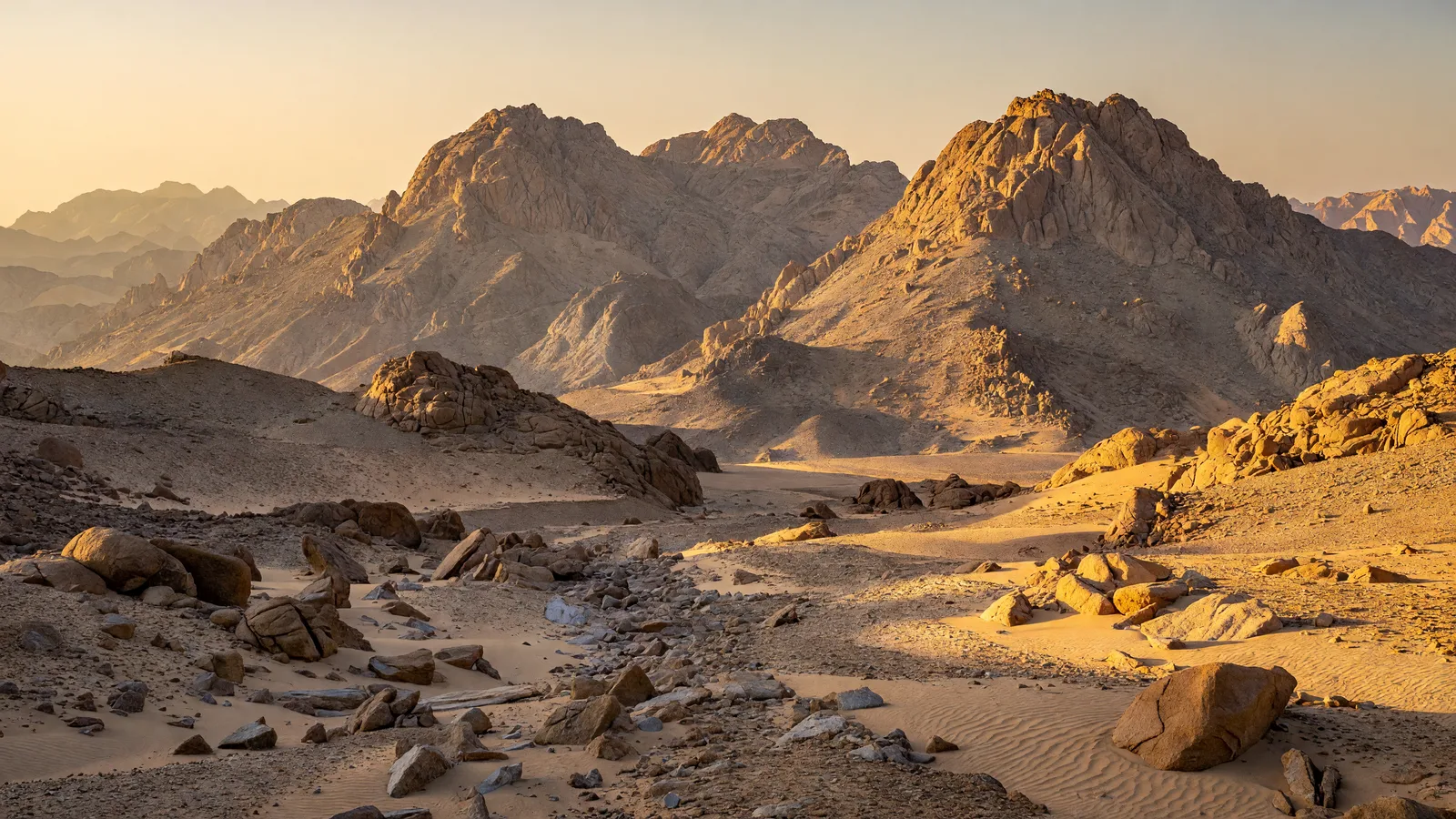
Exodus is the second book of the Bible. It is the story of Moses called to bring his people out of oppression in Egypt, their escape, and the covenant at the mountain, where they receive the Ten Commandments. That is the short form given by the Bible Odyssey dictionary entry. The same entry splits the book into smaller sections, from the new threat through the tent. The four movements on this page are ours. They only gather those sections: chapter 1 to 15, the threat and the departure; chapter 15 to 18, the wilderness; chapter 19 to 24, the mountain and the covenant; and chapter 25 to 40, the tent and what happens while it is being made.
Hold those four, and the book stops feeling like a pile of famous scenes. It picks up the family Genesis left in Egypt. A summary can set the movements in order. The chapters still have to be read.
Don't just read the Bible, understand it. For this book, that means knowing which movement you are in.
What the name is doing
The English title comes from the Greek name of the book, a word for departure or going out. The New World Encyclopedia also glosses the title as a mass migration or exiting of a people from an area, and notes that Jewish readers often call the book Shemot, Names, from its first words, "And these are the names." Chapter 1 opens on those names: the sons of Israel who went to Egypt with Jacob, each with his family.
Movement one: out of Egypt
The Bible Odyssey outline begins with a new threat, then Moses, then a contest with Pharaoh, then the departure, through the song at the sea. That is chapter 1 to 15.
Chapter 1 sets the threat. A new king comes to power in Egypt. The Egyptians appoint taskmasters over the Israelites to oppress them with forced labor. They build Pithom and Rameses as store cities for Pharaoh. The more they are oppressed, the more they multiply.
Moses is born into that pressure, flees, and is called back. In chapter 3 he turns aside to a bush that burns and is not consumed. God calls his name from the bush and tells him to take off his sandals. God gives the name to carry back to Israel: "I AM WHO I AM."
The contest with Pharaoh follows: signs, plagues, and the death of the firstborn, with the Passover set in the middle. In chapter 12 the LORD tells Moses and Aaron that the blood on the houses will be a sign. "When I see the blood, I will pass over you."
Then Pharaoh pursues. In chapter 14 the waters are divided, and the Israelites go through the sea on dry ground, with walls of water on their right and on their left. The Egyptians follow them into the sea. That night and morning are the exit the title names.
Movement two: the wilderness road
After the song at the sea, the Bible Odyssey outline places the people in the wilderness, from the end of chapter 15 through chapter 18. The scenes are practical, not spectacular: bitter water made drinkable, manna and quail, water from the rock, a fight with Amalek, and a visit from Jethro, Moses' father-in-law, who tells him he cannot judge every case alone.
This movement is easy to rush. It is where the rescued people learn they still have to be fed, and where complaint shows up as soon as the sea is behind them. Read it as the road to the mountain, not as a pause before the real book.
Movement three: the mountain and the words
The outline then gathers everything "at the mountain," and the first part of that stay is preparation, the Ten Commandments, and the covenant, in chapter 19 to 24.
Chapter 20 opens the commandments with the rescue still in the sentence: "I am the LORD your God, who brought you out of the land of Egypt, out of the house of slavery." The words that follow are about exclusive loyalty, the name, the sabbath, parents, and the life of a neighbor. The covenant meal and the writing of the words come in the chapters just after, still inside this movement on the Bible Odyssey map.
Movement four: instructions, a break, and a tent
The rest of the stay at the mountain, chapter 25 to 40, is mostly about a tent. The Bible Odyssey outline lists prescriptions for the tabernacle, then sabbath and covenant provisions, then the making of the tabernacle itself. The New World Encyclopedia names the break in the middle: the golden calf.
In chapter 32 the people grow tired of waiting for Moses and ask Aaron for gods. He makes a calf, and they say, "These, O Israel, are your gods, who brought you up out of the land of Egypt." The book does not end on that sentence. Moses pleads, the calf is destroyed, and the instructions are taken up again.
Chapter 40 is the finish. The tent is set up. The ark goes in. "The cloud covered the Tent of Meeting, and the glory of the LORD filled the tabernacle." Moses cannot enter, because the cloud has settled on it. When the cloud lifts, the people set out. The book that began with names in Egypt ends with God dwelling in the middle of the camp, and with a people who move when that presence moves.
Who carries the story
Moses is the person the book will not let you forget: the baby drawn from the Nile, the man at the bush, the one who stands before Pharaoh, the one who receives the words and pleads after the calf. Aaron is beside him, and Aaron is also the one who makes the calf. Pharaoh is the king who will not let the people go, until he does, and then pursues. Miriam sings after the sea. Jethro, Moses' father-in-law, meets him in the wilderness. The Israelites are not background. Their fear, their complaint, and their building of the tent are the plot.
If you came from the Genesis summary, you already know Joseph's family in Egypt and the promise that God would attend to them. Exodus is that attendance, and it is harder than a rescue scene. The people are brought out, and then they have to live with the God who brought them out.
A page for every book, if you want the set
This page is the Exodus thread only. When you want the same kind of page for each book, plus a short start, Understand the Bible: every book explained + 30 guided days is meant so you know what each book of the Bible is about before you read it, and can start reading with 30 short guided days. It is $12. What you receive is an instant digital download, one ZIP of PDF files, and nothing ships.
You can follow the four movements in your own Bible and leave the file closed. The limit of this page is the same as its use: it keeps the order, and it leaves the chapters to you.
Questions
What is the story of the Exodus from Egypt?
Exodus tells how the Israelites, enslaved in Egypt, are brought out under Moses, cross the sea, receive the covenant at the mountain, and build a tent where the glory of the LORD comes to dwell.
What does the word exodus mean?
The English title comes from a Greek word for departure or going out. One encyclopedia glosses it as a mass migration or exiting of a people from an area. In Hebrew the book is often called Shemot, Names, from its opening words.
Who wrote Exodus?
The book is the story of Moses and the departure from Egypt. Scholars see multiple sources and several authors, and readers differ on how the book came to be. The opening does not name a writer.
What is a famous verse from the Book of Exodus?
A line many readers keep is from the words at the mountain, in the Berean Standard Bible: I am the LORD your God, who brought you out of the land of Egypt, out of the house of slavery.
- Exodus
- Book of Exodus
- Exodus 1, Berean Standard Bible
- Exodus 3, Berean Standard Bible
- Exodus 12, Berean Standard Bible
- Exodus 14, Berean Standard Bible
- Exodus 20, Berean Standard Bible
- Exodus 32, Berean Standard Bible
- Exodus 40, Berean Standard Bible